
Downlights or
track lights?
Choose the effect before the fixture. Downlights are quiet and fixed. Track lights are visible and adaptable. A considered home often needs both—but usually fewer of each than expected.
Use downlights for certainty.
Use track for change.
A downlight belongs where the ceiling position, furniture and task are unlikely to move. Its strength is visual quiet: a controlled pool of light with very little fixture in view.
A track belongs where art, furniture or use may change—or where several distributions must share one feed. Its strength is not simply adjustability. It is the ability to combine spot, flood, wall-wash and pendant light on one planned line.
Neither fixture is a complete lighting plan. Ambient light makes the room usable. Task light supports work. Accent and vertical light reveal material, objects and depth.
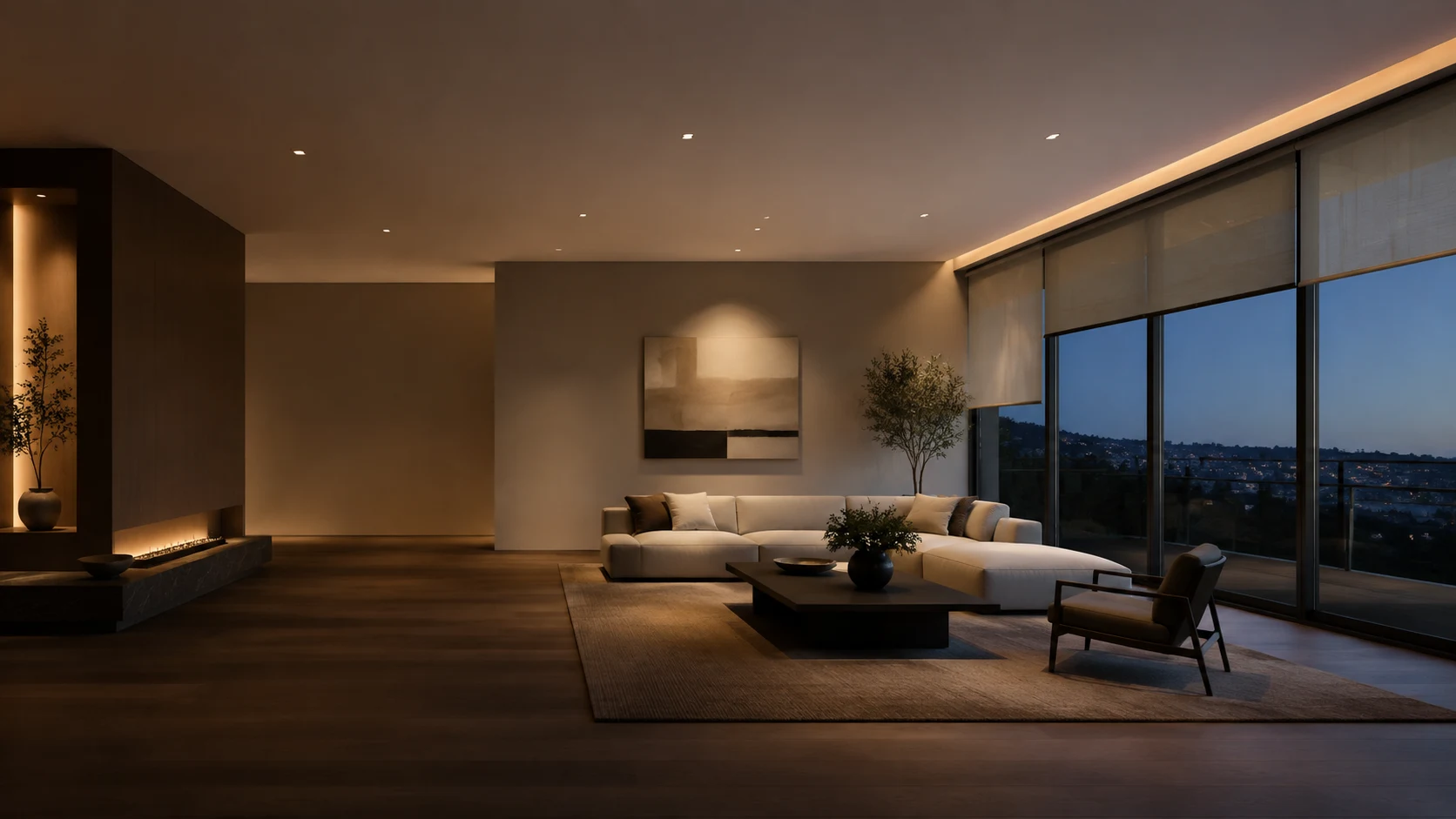 Fixed light · quiet ceiling
Quiet. Fixed.
Architectural.
Best for stable furniture plans, passages, bathrooms, counters and controlled pools of general light.
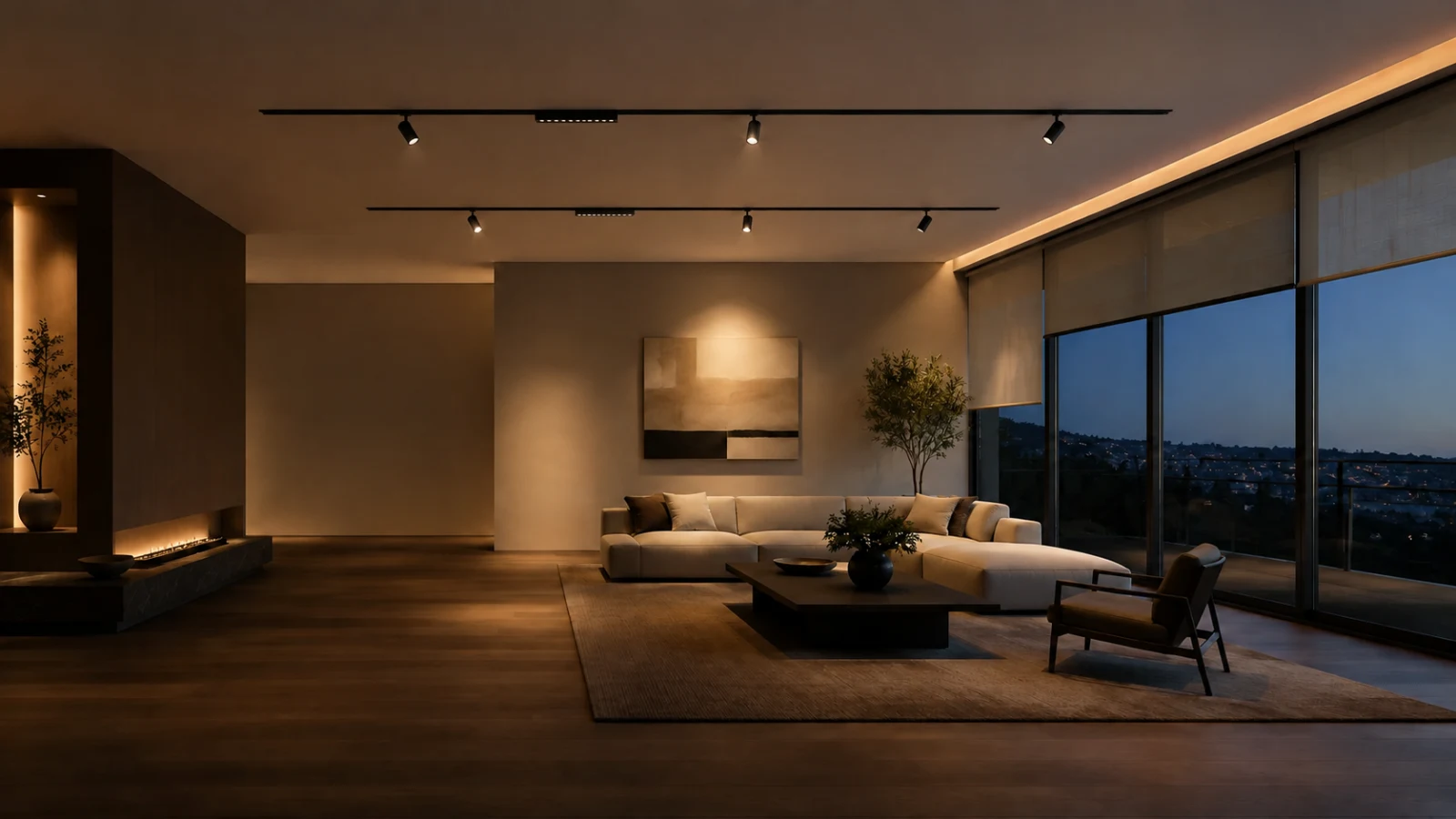 Aimable light · adaptable system
Visible. Aimable.
Adaptable.
Best for art, walls, collections, evolving rooms, hospitality and ceilings that need several optical roles.
Do not begin
with a ceiling grid.
Light the room, not the floor plan
A uniform grid of downlights makes installation easy to draw, but it rarely makes a room feel composed. It often over-lights circulation, leaves faces in shadow, creates scallops in the wrong places and turns every ceiling aperture into a source of glare.
Begin by marking the surfaces that matter: the kitchen worktop, dining table, reading chair, artwork, curtain, textured wall and route through the room. Then decide whether each target is fixed or likely to move.
Choose downlights when the target is known
Use them above stable tasks, in compact utility spaces, or where a deep-set source can quietly add ambient light. Adjustable recessed downlights can aim at a wall or artwork while keeping the ceiling calm, but their movement remains limited and their cut-outs are permanent.
Choose track when the room must adapt
A track system is useful when artwork rotates, a dining table may move, a living room needs seasonal arrangements, or one ceiling line must carry different optics. Surface track also avoids a field of permanent cut-outs. Recessed magnetic track is visually quieter, but it must be coordinated early with ceiling depth, supports, drivers and access.
Use both when each has a clear role
A few low-glare downlights can provide dependable task and circulation light. A short track can wash a wall and pick out art. Concealed linear light or a pendant can supply the softer ambient layer. The ceiling becomes quieter because no single fixture is asked to do everything.
Specify the
light delivered.
These are residential design targets, not substitutes for a room calculation or a project photometric study.
| Decision | Downlight | Track light |
|---|---|---|
| Purpose | Fixed ambient, task or wall-wash layer | Adjustable accent, task, wall wash or ambient layer |
| Beam | 24°–36° for controlled pools; 40°–60° for softer general light; asymmetric optic for walls | 10°–24° for accents; 24°–36° for flexible task light; 45°–120° modules for flood and ambient light |
| Output | Specify delivered lumens and illuminance on the task—not wattage alone | Specify each head by the surface, distance and beam; avoid one high-output module doing every job |
| Colour | 2700–3000 K for living and bedrooms; 3000–3500 K for kitchens; keep one visible zone consistent | Match the room CCT and colour metrics across every module on the rail |
| Rendering | CRI Ra ≥90; R9 ≥50. For food, skin, timber and art: Ra ≥95 and R9 ≥80, with a TM-30 report | The same targets; request the TM-30 report for spot, flood and linear modules separately |
| Consistency | ≤3 SDCM; ≤2 SDCM where adjacent pools share a wall or ceiling | ≤3 SDCM across the system; ≤2 SDCM for closely spaced modules and replacement batches |
| Visual comfort | Deep baffle, shielded source and an optic chosen for the ceiling height | Lockable aiming, glare shield or snoot where needed; keep bright apertures out of normal sightlines |
| Control | Smooth dimming to 1% where scenes matter; confirm driver compatibility and performance at low level | Individually addressable or sensibly grouped heads; scenes should not depend on moving each light by hand |
| Evidence | Photometric file, driver data, flicker metrics, lumen maintenance and warranty | The same, plus rail loading, voltage drop, mechanical retention and spare-module compatibility |
CRI is a start.
Not the answer.
Average fidelity
General CRI, or Ra, averages eight comparatively low-saturation test colours. It is useful for a first filter, but two sources with the same Ra can render a room differently.
Saturated red
R9 is reported separately and is not included in Ra. It matters to skin, food, timber, terracotta and warm fabrics—the colours that make homes feel alive.
TM-30 fidelity
TM-30 Rf evaluates average fidelity across 99 colour evaluation samples. It is broader and more uniform than Ra, although any single average can still hide local shifts.
TM-30 gamut
Rg describes average saturation relative to the reference. Around 100 is neutral; above 100 is more saturated; below 100 is less. The colour-vector graphic shows where those changes occur.
One number cannot
describe a spectrum.
For principal rooms, Sense uses Ra ≥90 as the entry point—not the finish line.
Everyday residential light
Ra ≥90, R9 ≥50, TM-30 Rf ≥85 and Rg 95–105 are useful practical targets for a natural, balanced result.
Food, skin, timber and art
Prefer Ra ≥95, R9 ≥80, TM-30 Rf ≥90 and the full colour-vector graphic. Review the actual object under a sample when colour is critical.
Consistency across a room
Specify CCT, Duv or tint information, and ≤3 SDCM. Use ≤2 SDCM where beams overlap or adjacent fittings illuminate the same pale surface.
At every operating state
Check fixed-white and tunable products at the CCTs and dimming levels you will use. Colour quality, output and efficacy can change across the range.
Better colour can cost
some efficacy.
High colour fidelity needs a fuller spectrum, particularly in red wavelengths where human vision produces fewer lumens per watt. That can lower efficacy. It does not make high-CRI light unsustainable.
The difference is about 1.6 W while on. Real products vary: compare complete-luminaire lumens, input watts, optics and delivered light—not LED-package efficacy or CRI alone.
Recover more than the colour penalty
A narrow beam that lands useful light on art, a wall washer that brightens the vertical plane, or task lighting that lets the ambient scene run lower can save more energy than choosing a higher-efficacy source and wasting its output. Dimming, vacancy control and daylight response reduce operating hours without reducing colour quality.
Do not over-specify every circuit
Use the highest colour quality where people, food, finishes and art benefit from it. A store, utility or secondary circulation space may not need the same target. Keep the visible open-plan zone consistent; make exceptions deliberately, not by mixing whatever is available.
Use fewer fittings.
Keep them longer.
- 01
Design to target illuminance and surface brightness. Do not use a ceiling grid as a substitute for a lighting calculation.
- 02
Choose efficient optics and the correct beam before adding wattage. Count delivered light on the task, wall or object.
- 03
Prefer serviceable luminaires with replaceable drivers, light engines and optics—and written availability for those parts.
- 04
Specify tested lumen maintenance and colour stability at the luminaire’s real operating temperature, not an unexplained “50,000-hour” claim.
- 05
Use dimming, vacancy sensing, daylight response and scenes. For connected lighting, include standby power in the energy comparison.
- 06
For track, leave electrical and physical capacity for future modules, but do not populate every metre on day one. Re-aim and reuse before buying more.
- 07
Ask for repair, take-back and recycling routes. Aluminium, electronics, magnets and drivers should not become one inseparable waste object.
Seven lines for
every luminaire.
Role + target
Ambient, task, accent or wall wash; identify the surface and required illuminance or appearance.
Photometry
Delivered lumens, beam angle, intensity distribution and an IES or LDT file for the actual optic.
Colour
CCT, SDCM, CRI Ra, R9 and the complete TM-30 report—including Rf, Rg and vector graphic.
Electrical
Complete-luminaire input watts, efficacy, power factor, driver and standby power where connected.
Control
Dimming protocol, minimum stable level, fade behaviour, tunable range and scene or group logic.
Comfort
Cut-off, source luminance, baffle or accessory, aiming limits and flicker data: PstLM and SVM.
Life + repair
Lumen and colour maintenance, rated ambient temperature, warranty, replaceable parts and spares.
Design the light.
Not the ceiling.
Downlights are best when their work is known and their visual quiet matters. Track lights are best when the target, optic or room may change. Used together, they create a calmer ceiling and a more adaptable room than a dense grid of either.
Specify beam, output, glare, colour and control as one system. Ra is only the first filter; R9 and TM-30 reveal more of the spectrum. Then reduce energy through placement, optics, dimming, operating hours and repairability. Good lighting is not the most light. It is the right light, kept useful for longer.
The numeric recommendations are Sense residential design targets, not universal compliance limits. Final output, spacing and aiming depend on room geometry, reflectance, mounting height, visual tasks and the tested photometry of the selected luminaire.
- U.S. Department of Energy · LED basics, colour quality and efficacy ↗
- U.S. Department of Energy · TM-30 frequently asked questions ↗
- Illuminating Engineering Society · TM-30 colour evaluation samples ↗
- Illuminating Engineering Society · Gamut Index Rg ↗
- CIE · Position statement on colour quality metrics ↗
- U.S. Department of Energy · LED luminaire lifetime and serviceability ↗
- European Commission · Ecodesign requirements for light sources ↗
Turn the room plan
into a lighting brief.
Explore the Sense downlight families and 48 V magnetic track system, then plan the layers, scenes and controls around how the room will be used.